How to Plan Birthstone Colors for a Multigenerational Family Piece
Plan multigenerational birthstone colors with a generation, name, month, and position map that preserves accuracy before reviewing the combined palette.

Birthstone colors for multigenerational family jewelry should be planned from people to palette, not palette to people. List every included generation, approved name, confirmed birth month, and intended position before viewing the colors together. Then evaluate how the accents combine without changing a month to make the design more coordinated. Accuracy gives the piece its family meaning.
Define the generations and inclusion rule
“Multigenerational” may mean grandparents, parents, and children, but the exact group differs by family. It can include step-relatives, adoptive relatives, or chosen-family elders. Write the inclusion rule in one sentence so contributors know who belongs on this piece.
A rule such as “the recipient, her two children, and all four grandchildren” is clearer than “the whole family.” Count the resulting names and compare that count with the product capacity before discussing color. If the design cannot include everyone described by the rule, select another format rather than quietly removing one branch.
The guide to planning family name counts offers useful capacity questions even when the final piece is a ring.
Create a generation-name-month-position map
Use one row per person and four columns: generation or family branch, exact display name, full birth date and month, and proposed position. Generation is a planning label, not necessarily part of the engraving.
Confirm dates from a reliable family source. Birthstone traditions and alternatives can vary by place and era, but the actual calendar month remains the field you can verify. The family birthstone month guide can help translate those months into the current visual convention.
Choose a position rule: oldest-to-youngest, family branches kept together, alphabetical, or a balanced order approved by the recipient. State the rule so a later reviewer does not rearrange names only because one color combination looks more varied.
For branch grouping, draw a light divider between households on the worksheet but do not assume that divider appears on the jewelry. It is an editing aid. Number every final position continuously so the product fields remain one sequence and no person is skipped when moving from one branch to the next.
Review the color pattern without editing facts
Once the map is locked, add a broad color note beside each month. Look for repeated months, runs of similar colors, and strong transitions. These observations help you understand the finished cluster, but they are not reasons to substitute months.
Repeated accents can show a family pattern: several generations may share one birth month. Similar neighboring colors may appear less separated at small scale. That is acceptable when each name, position, and month remains documented. A gift message can call attention to a repeated month without presenting it as a personality trait.
Use two mock arrangements only when the family order is flexible. Label one “branch grouping” and the other “alternating generations,” then ask which relationship logic the recipient would understand. Do not call the most colorful version automatically better.
Ask contributors to review facts before aesthetics. First circulate a plain table with no color swatches; after names and months are approved, add the broad color view. This order reduces the temptation to “correct” an accurate month because a coordinated palette looks more orderly.
Check capacity and scale on the actual design
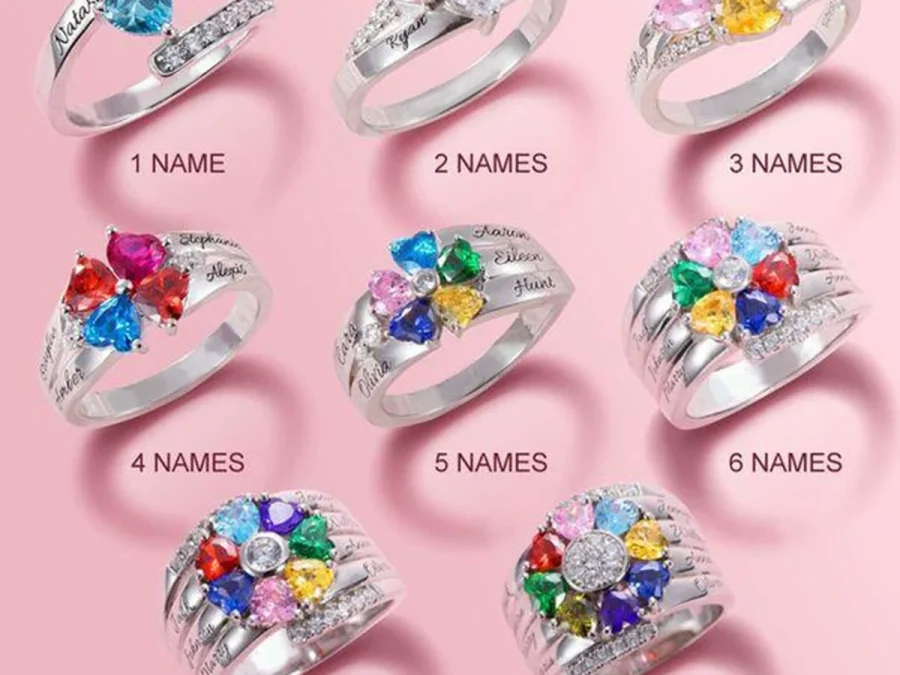
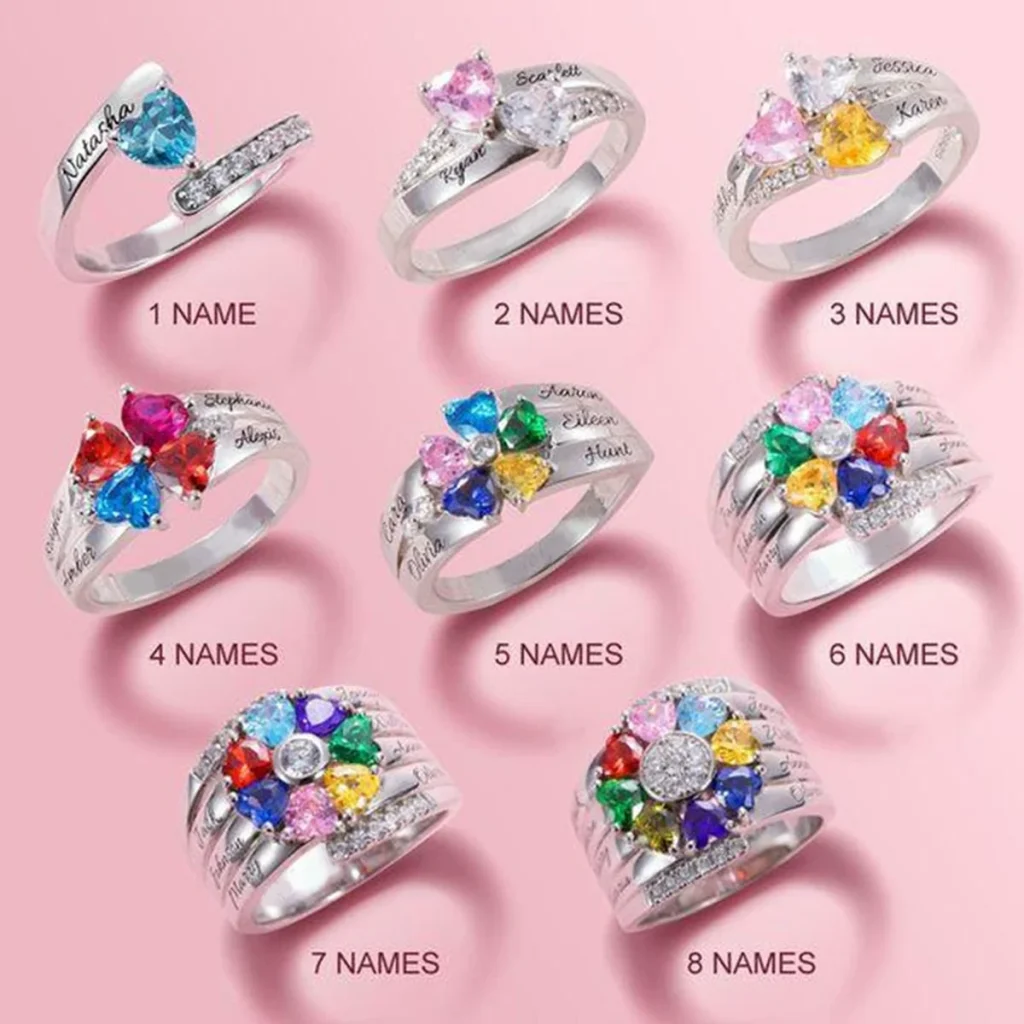
The Family Constellation Name Ring supports one to eight simulated birthstone accents and a name or short engraving. It is available in whole US sizes 6 through 10. The colored cluster changes as accents are added, so review examples for relative layout while remembering that close-up images enlarge the details.
A ring places several generations in a compact area. The accents help create a collective visual pattern, but they cannot individually display long biographies. Keep the engraving concise and use the map as the full key. If the intended group exceeds eight people or needs a separate name for every accent, compare other structures in the Amorieva collection.
Think about who needs to understand the map. The recipient may recognize every month immediately, while other relatives may need the written key included with the gift. Prepare that explanation yourself; do not imply that the small ring surface can communicate generation labels that are not part of its fields.
Follow the personalization process for the final field review. The Family Constellation ring does not currently offer a three-tone finish selector, so do not import that choice from another product.
Common questions
Should each generation have its own color family?
Not in an accurate birth-month design unless the confirmed months naturally create that pattern. Generation is an organizing layer; the selected accent should still reflect each person’s actual calendar month.
How do I handle several relatives with the same month?
Repeat the month selection. Keep names and positions clear, and explain the shared month in the gift message if it is meaningful. Repetition can be an authentic family feature.
Can I rearrange positions for better color contrast?
Yes, when the family order is genuinely flexible. Compare two documented arrangements and preserve the inclusion rule. Do not create a hierarchy the recipient would misunderstand merely to alternate colors.
Let the palette reveal the family as it is
A multigenerational color pattern becomes meaningful because it emerges from real names and dates. Define the group, map every person, choose an explainable order, and only then observe the palette. Similar colors and repeated months are not problems to design away; they are part of the family record the piece was chosen to hold.