A Personalized Family Gift for Someone Who Does Not Wear Jewelry
Choose a personalized family gift for a non-jewelry wearer by respecting that preference and planning a round or heart keyring with verified names.
A personalized gift for someone who does not wear jewelry should respect that preference instead of trying to overcome it. Choose a carried family format the recipient already uses, such as a keyring, and plan its names and month accents with the same care as a necklace or bracelet. Meaning does not depend on wearing the object on the body.
Find out what “does not wear jewelry” means
The recipient may dislike the feel of necklaces, avoid wrist pieces during work, prefer not to wear rings, or simply have no interest in accessories. Do not assume that a sentimental occasion will change that habit.
Ask what objects she does carry: house keys, car keys, a work badge, a tote, or a daily bag. A keyring only fits when there is a realistic place for it. Someone who uses phone-based entry and carries no keys may prefer another non-wearable gift.
Run a one-week observation test when the gift is not urgent. Note which item leaves the house with her every day and whether it already carries decorative attachments. A keyring that has no natural home can become another object to store, which misses the purpose of respecting a non-wearer.
Observe function as well as style. Does she favor simple round hardware or heart motifs? Does she keep keys minimal, or enjoy several small personal objects? The answers shape the design more reliably than a generic gift category.
Use a current carried format
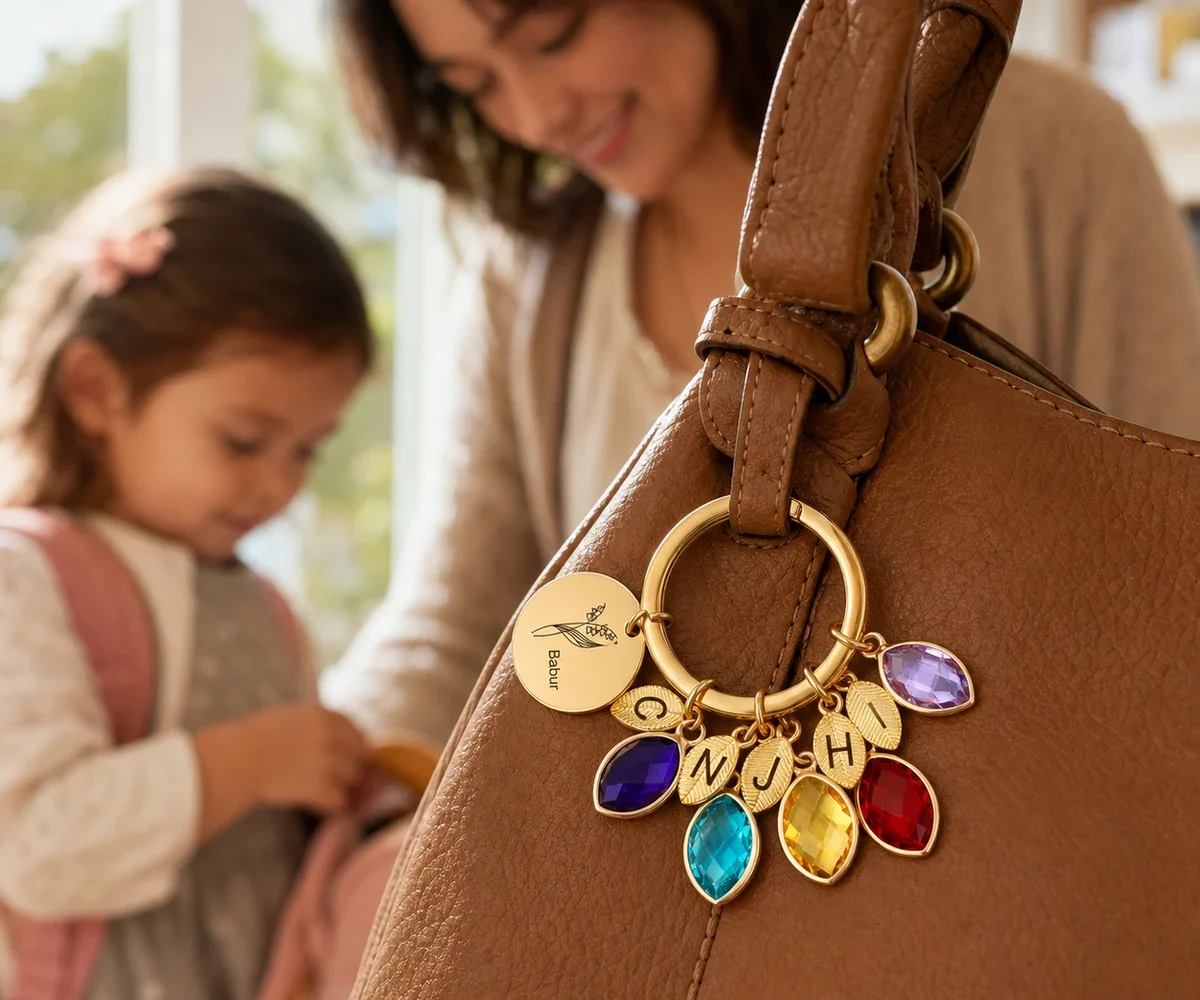
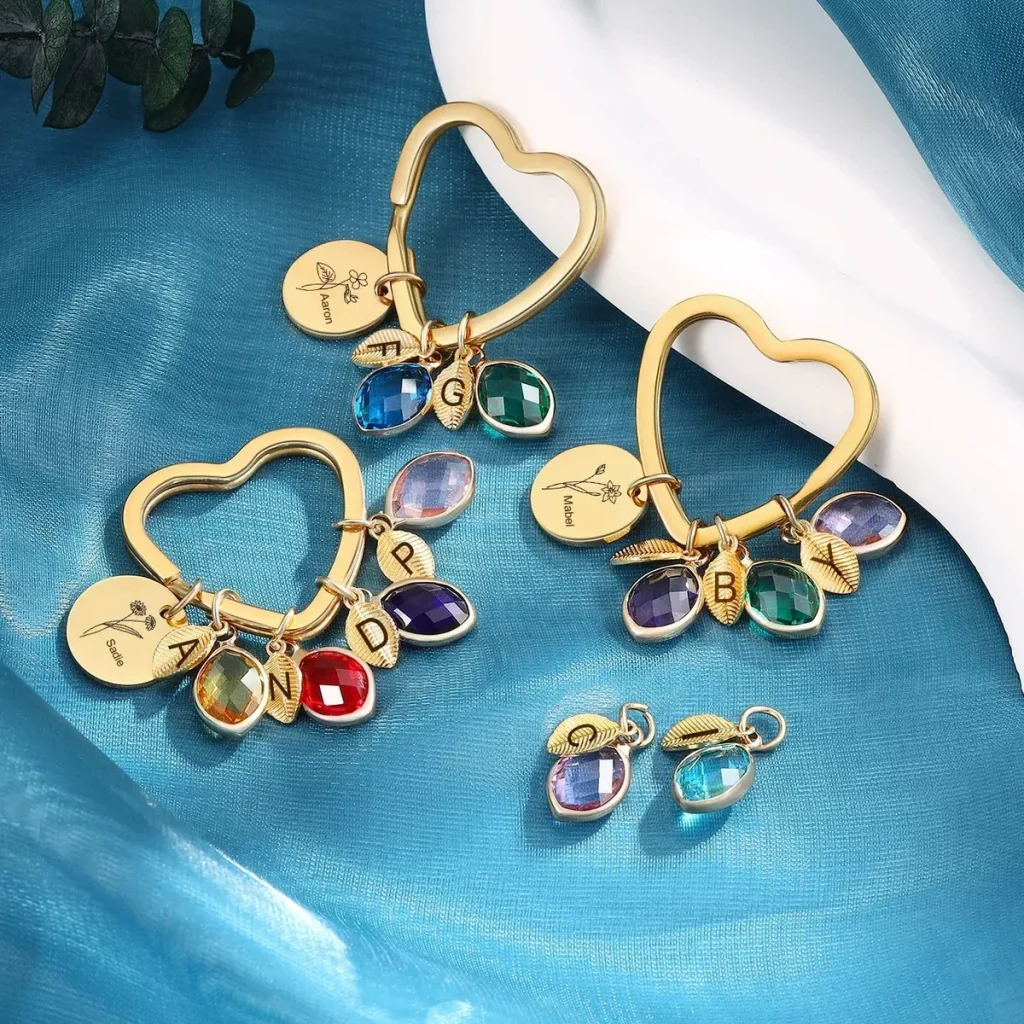
The Family Branch Birthstone Bangle and keyring can be configured as a round keyring or heart keyring in addition to its wearable bangle format. The keyring version supports one to five engraved name leaves with simulated birthstone accents and a center disc. The round ring is approximately 30 mm and the heart ring about 31 mm.
Choose round for a more neutral outline or heart when the recipient already welcomes that symbol. Neither shape changes the one-to-five-person structure. The center disc can carry a short shared message through the current Special Note workflow, while the leaves identify individuals.
Do not confuse this current family-branch keyring option with a different product or assume additional shapes and icons that are not listed.
Consider weight and movement qualitatively. One-to-five leaves, a center disc, and colored charms create a decorative cluster, so a recipient who keeps a very minimal key set may prefer fewer names or another gift format. Do not fill all five positions merely because they are available.
Plan the carried family story
Create two information levels. On the first line, write one compact center message. Below it, list one to five approved names, each beside the actual birth month. Keep names and month choices paired throughout entry.
Use this checklist:
- Recipient genuinely carries keys or a suitable bag.
- Round or heart outline matches her existing objects.
- Center-disc wording is brief and explicitly labeled in the note.
- Each leaf has one exact name and one confirmed month.
- The order follows age, alphabetical order, timeline, or recipient preference.
- Tone and quantity have been reviewed separately.
Amorieva’s personalization process overview explains why live fields and confirmed details matter. Do not use a note to request an unlisted product structure.
Write the center instruction in a labeled form such as “CENTER DISC TEXT:” followed by the exact short wording. Keep greetings and background explanations outside that line. Then review each leaf as a separate name-and-month pair so the unifying message does not blur the individual fields.
Consider daily contact and care
A keyring is not worn, but it still experiences handling and contact. Keys, coins, bag hardware, and hard surfaces can rub against the plated disc, leaves, and accents. Keep it out of damp compartments and avoid attaching it where it will repeatedly strike heavy objects.
Wipe it gently with a soft lint-free cloth and store it separately when not in use. Keep it dry and away from perfume, household chemicals, saltwater, and chlorinated water. The current care guidance applies to the plated personalized components.
If the recipient’s key routine is too rough or wet for a decorative keyring, respect that evidence. Compare other ideas rather than presenting care as a test of gratitude.
Ask whether she wants the family reference visible in public. A carried item can be noticed just as jewelry can. Initials or a more private gift may fit better when names should not be displayed on everyday keys or a work bag.
Common questions
Is a keyring still a jewelry gift?
It is a personalized family accessory using jewelry-like engraved and colored details, but it does not need to be worn. Describe it as the carried object it is and choose it for the recipient’s routine.
Should I choose round or heart for a minimalist?
Round may offer a quieter outline, but use the recipient’s actual objects as evidence. A minimalist who values heart symbols may still prefer heart; another may want no decorative keyring.
Can I include more than five names?
The current Family Branch configuration supports one to five name leaves. If the intended group is larger, compare capacities in the Amorieva collection rather than omitting people without a clear reason.
Give personalization a form the recipient will use
A non-jewelry wearer does not need to become a necklace, cuff, or ring wearer to receive a family keepsake. Start with the objects she already carries, choose a round or heart keyring only when it fits that routine, and verify every center and leaf detail. Respecting how she lives is part of the personalization, not a compromise around it.