A Fact-Check Checklist for Personalized Jewelry Claims
Verify personalized jewelry claims by tracing materials, accents, fields, capacity, care, policies, and service language to current documented sources.
A personalized jewelry claims checklist should trace every purchase-relevant statement to a current source. Verify material wording, accent type, supported fields, capacity, size, care, shipping and return policy, and any service promise separately. Attractive tone words and social signals can help describe a brand, but they should never substitute for a specification or a field visible on the product page.
Sort statements into five evidence boxes
Create columns for product specification, personalization field, site policy, care instruction, and unverified marketing language. Copy each important statement into one box and record its source path and review date.
A product title is not automatically a complete materials statement. A lifestyle image is not a size chart. A general note field is not a supported modification service. Classifying the statement exposes what kind of evidence it actually needs.
Add a confidence label: confirmed, time-sensitive, unclear, or unsupported. Time-sensitive facts should be rechecked immediately before ordering. Unclear statements become questions. Unsupported statements are removed from the purchase comparison instead of being treated as probably true.
Verify the product structure first
Confirm these facts on the current product page:
- Base construction and finish wording.
- How colored or crystal details are described.
- Number of names, months, pieces, or accents.
- Available sizes, formats, and tones.
- Required fields and limits stated for this design.
Do not infer an option because another product offers it. Current Amorieva designs differ: some use month-linked simulated birthstones, some are name-only, and one ring lacks the three-tone selector found on several other pieces.
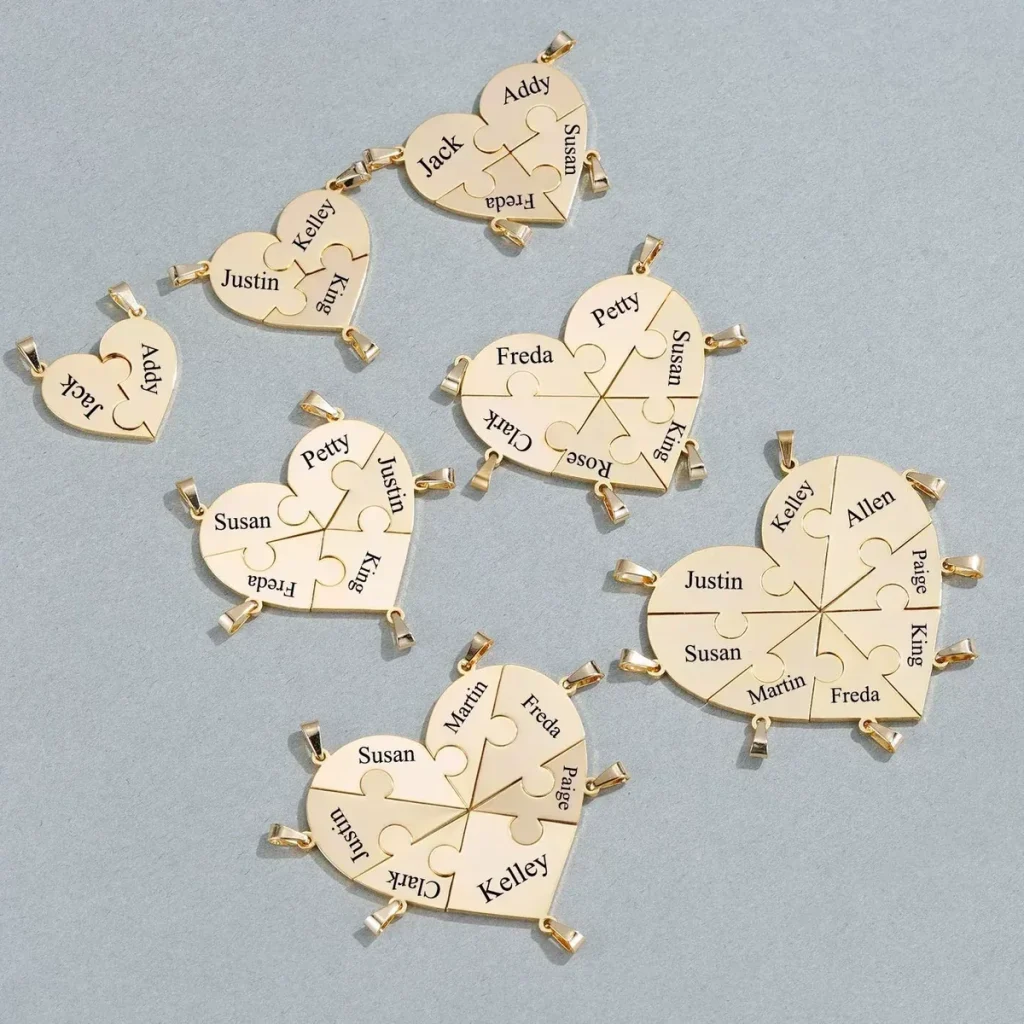
Test a current name-only product
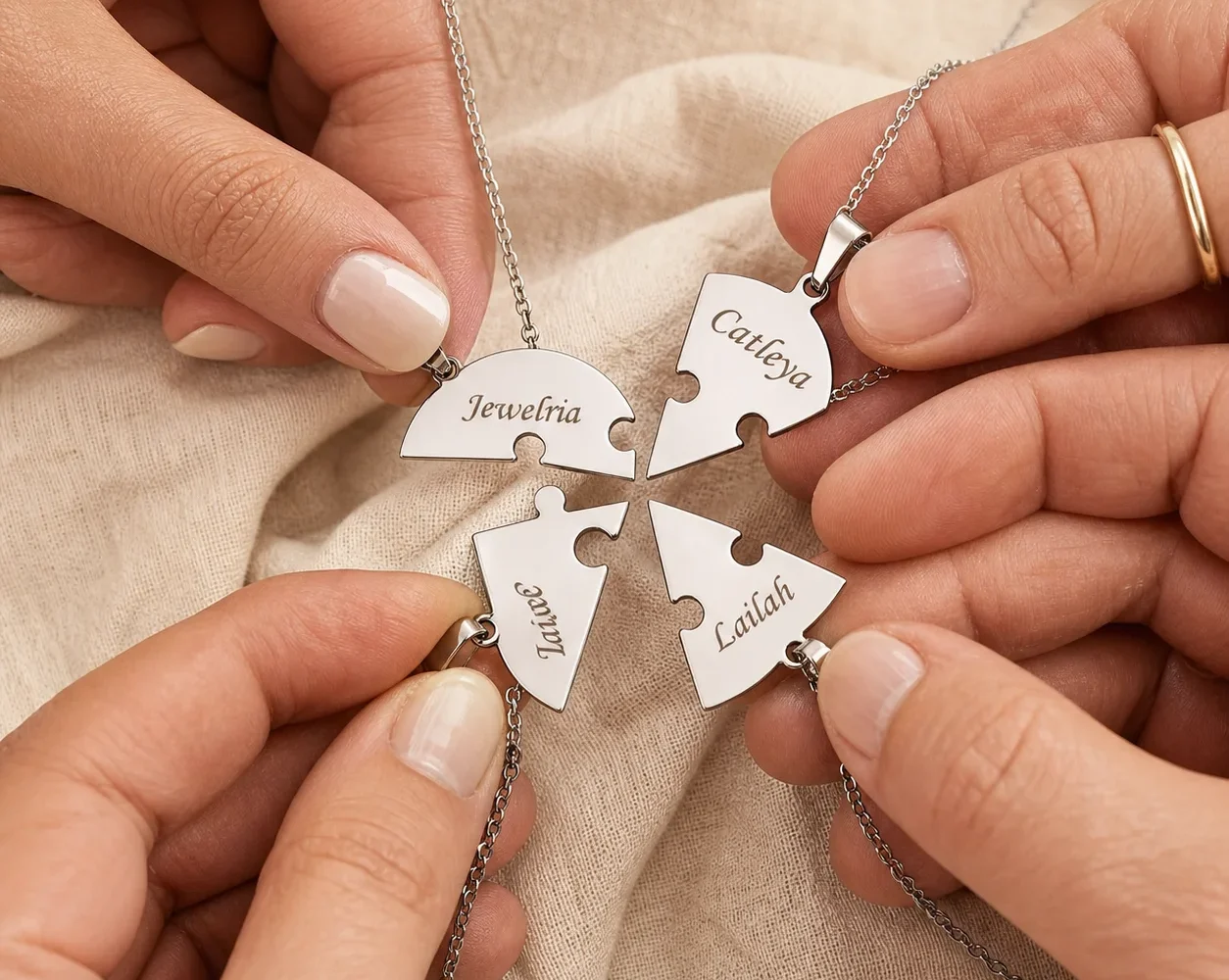
The Together Heart Puzzle Necklace provides a clear example. Its current documented structure is plated stainless steel, two or three interlocking heart pieces, one engraved name per piece, and three finish tones.
The design has no birthstone field. A photograph with bright reflections would not create one. Its two-to-three-piece capacity also does not establish later add-on service, a keyring version, or support for a fourth name. Those would require separate current documentation.
Use the options guide to understand the shared layout, while treating the live product fields as the source for the order you can place today.
Check policies on their own pages
Shipping, return eligibility, preparation timing, address coverage, and problem-order steps can change. Review the current shipping and personalized-order policy at the time of purchase. Do not transfer a policy from a different seller or rely on an old promotional image.
Likewise, read the current care guidance before turning a broad performance phrase into an expectation about water, chemicals, exercise, or long-term surface appearance. Materials and care are related, but one does not prove the other.
Evaluate social and service language carefully
Popularity language, quoted experiences, badges, and promotional adjectives may influence trust, but they do not establish the composition or fields of the item you are reviewing. Look for a source you can inspect, a date, and a clear connection to the exact product.
Service statements need equal precision. Ask whether a change, proof, repair, or add-on is currently available for the exact design. A general promise to “help” should not be rewritten as a guaranteed technical outcome. Use the Amorieva FAQ for current support boundaries.
Check whether a quoted experience refers to the same product, option set, and policy period. Even a sincere account cannot establish current materials or fields by itself. Use it to form a question, then return to the present documentation for the answer.
Make a final documented decision
After verification, summarize only supported facts and compare the result with the recipient brief. If an essential claim remains unverified, pause or choose another documented option from the Amorieva collection. Do not lower the evidence standard because the gift date is near.
Save the reviewed page paths and date with your order planning notes. That record explains what the buyer relied on without claiming that site information can never change.
Use a second person for the final pass when the order includes several names or policies matter to the occasion. Ask them to trace each sentence to its box and source rather than simply agreeing that the summary sounds reasonable.
Delete any line that cannot be traced and is not necessary to the choice. A shorter verified comparison is stronger than a detailed brief built partly from assumptions.
Common questions
Does a product image prove the material?
No. Images show appearance and can help with layout, but lighting and screens vary. Use the written current materials specification for composition and finish.
Can a note request an option missing from the form?
Do not assume so. Ask whether the exact request is supported before ordering. A supplementary note should clarify available choices, not invent another product configuration.
How recent should policy evidence be?
Review it when you are ready to order because service and shipping details can change. Keep the date and page path in your private purchase record.
Make every important statement traceable
Fact-checking is not about distrusting every description; it is about assigning each statement the right source. Product fields verify personalization, specifications verify construction, and policy pages verify service boundaries. Once those roles are clear, the buyer can choose from documented facts instead of persuasive gaps.