Family Jewelry for a Multigenerational Household: Who Appears?
Plan multigenerational household jewelry by defining whether it represents current residents or the wider family, then confirming each displayed name.
Multigenerational household jewelry needs a clear scope before it needs names. Decide whether the piece represents everyone currently sharing the home, one branch of the wider family, the recipient’s descendants, or another approved group. Then confirm each display name and birth month. A household address alone should not decide who belongs or who is omitted.
Write the scope in one sentence
Examples include “the people living in this home today,” “Grandma and the grandchildren she cares for,” or “three generations in this family branch.” The sentence turns a complex household into an inclusion rule another reviewer can understand.
Do not blend current residents and distant relatives casually. A person can be deeply important without belonging in the specific household story. Conversely, a non-relative who shares the home may be part of the family as the recipient defines it.
Ask the wearer, not the family census
The recipient should be comfortable with the final group and the language used. Confirm whether step-relatives, chosen family, partners, adult children living elsewhere, or temporary residents belong. Avoid making living arrangement a public statement someone did not choose.
If the gift must remain a surprise, ask one trusted household member to verify the scope. Do not run a large vote that turns personal relationships into a ranking exercise.
Use a current-household snapshot with columns for resident, approved display name, relationship language, month permission, and verifier. The document is not a census; include only information needed for the gift. Store it privately and remove people who are merely being considered.

Fit a one-to-six connected-band layout
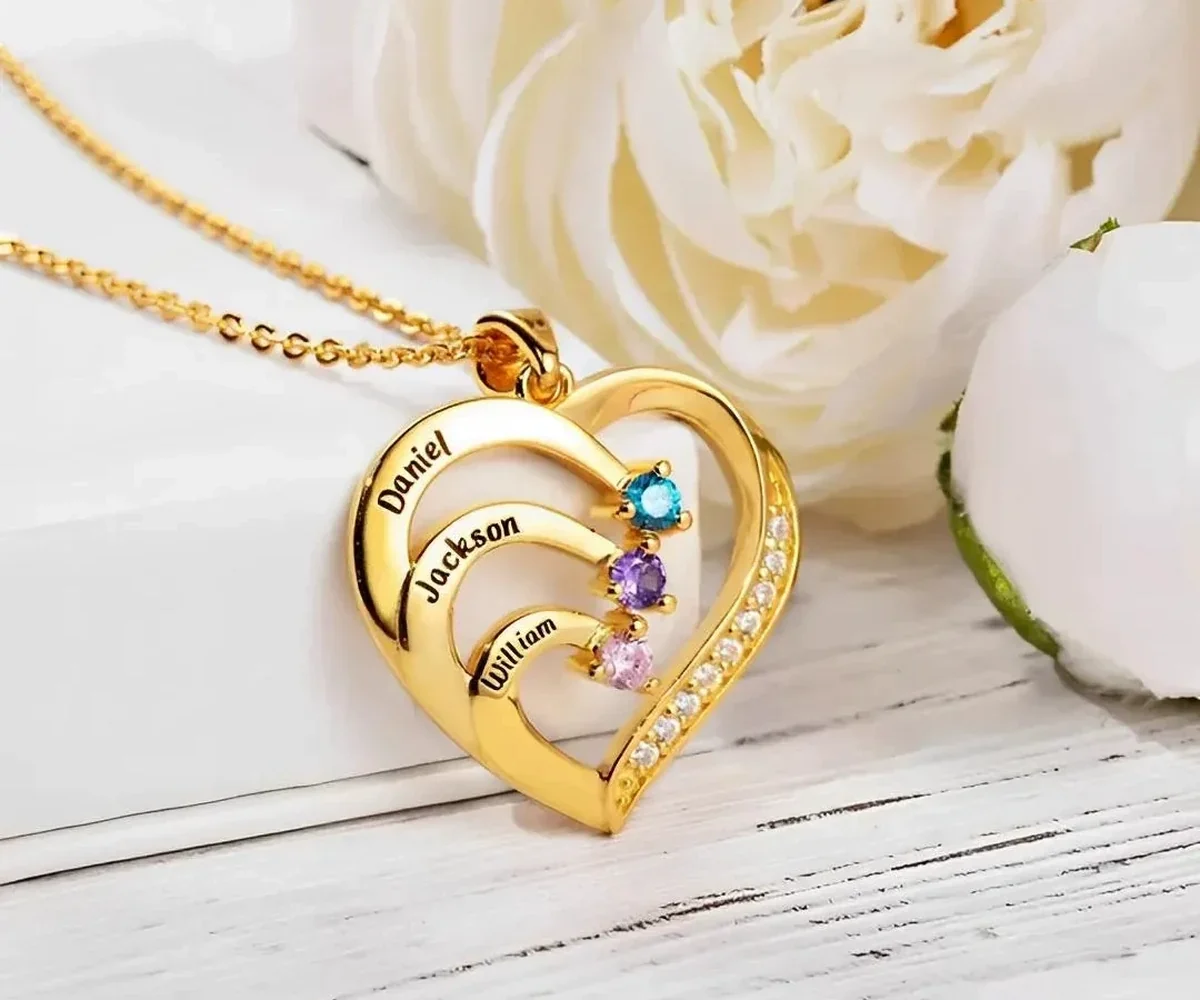
The Family Embrace Heart Necklace currently supports one to six loved ones, with each engraved name paired to a simulated birthstone selection. It uses connected curved bands in a plated mixed-metal heart and offers three finish tones.
This structure can suit a household list of six or fewer people when the recipient enjoys one unified pendant. Use one position for every approved name-and-month pair. If the household contains more than six intended people, do not combine names into one band or use a general note to request extra positions.
Compare a higher-capacity name-only design through the Amorieva collection, narrow the scope with the recipient, or choose another family object.
Consider an example household with one grandparent, two parents, and three children. Six approved people fit the current one-to-six structure. Adding an adult sibling who lives elsewhere changes the scope from household to wider family, so the group should decide that explicitly rather than squeezing in a seventh name.
Choose an ordering rule that avoids hierarchy
Possible orders include oldest to youngest, generation by generation, or recipient first followed by household members. Write the rule at the top of the worksheet. Position should explain structure, not announce which generation matters most.
Keep each name and month on the same row. Repeated months are accurate when relatives share them. Do not alter a month to separate generations by color.
Generation order can make the design easier to explain, but do not assume every family wants oldest first. A recipient-centered order may begin with the wearer, followed by other residents. If connected bands cannot guarantee exact visible placement, describe the sequence as the submitted record rather than a promise about final hierarchy.
Plan for a household that can change
A multigenerational home may gain or lose residents over time. Present the piece as a record of the approved current chapter, not a permanent census or a promise that living arrangements will remain the same.
Amorieva’s personalization process can help freeze the present list before ordering. The current FAQ should resolve field questions, but it cannot decide whether a person belongs in the family’s definition.
Present the piece as a chapter of shared home life. Avoid declaring that the engraved list proves who counts as family or who will always live together. If a resident later moves, the necklace can remain an honest record of the period when the household was configured this way.
Ask permission before showing the engraved names in public photographs, especially when children or dependent adults are included. Household intimacy does not automatically equal public consent.
Common questions
Should relatives who live elsewhere be included?
Only if the chosen scope and recipient preference include the wider family. Do not mix household and extended-family rules without stating the decision clearly.
What if more than six people share the home?
The current Family Embrace design supports one to six pairs. Choose another supported structure or revise the scope with the recipient rather than compressing names.
Does the oldest person need the first position?
No universal rule applies. Select an approved sequence and document it. First position should not be treated as a measure of family importance.
Let the household define the list, not the other way around
A multigenerational piece becomes clear when everyone can explain what it represents. Define the household chapter, verify the people and names, respect capacity, and treat the result as one moment in a living family. The pendant then gathers generations without pretending to summarize every relationship.
Keep the scope sentence with the submitted record so later viewers understand why these six or fewer names appear together.