Personalized Family Jewelry for an Empty-Nest Transition
Plan personalized family jewelry for an empty-nest transition by confirming the current family circle, adult children's names, months, and the wearer's routine.

For an empty-nest transition, choose personalized family jewelry that represents the relationships as they exist now rather than copying an old household roster. Confirm each adult child’s preferred name and birth month, decide whether the wearer belongs in the design, and select a format that fits the recipient’s current routine. The gift can mark connection across homes without defining the transition as loss or freedom for them.
Ask what the transition means to the recipient
“Empty nest” can feel celebratory, difficult, ordinary, or inaccurate. A child may have moved temporarily, returned home, or formed another household while remaining deeply connected. Do not write the gift message around an emotion the recipient has not expressed.
Ask whether a family piece would feel welcome and whether the focus should be all children, the couple, the whole immediate family, or another group. A direct conversation can preserve more meaning than a completely surprising roster.
Keep moving dates, bedroom jokes, and assumptions about future visits out of the engraving unless the recipient specifically wants supported text.
Choose the timing with care. Giving the piece on moving day may feel supportive to one family and premature to another. Ask whether the recipient wants to mark the transition now, at a later gathering, or not as an occasion at all.
Build a current relationship map
Place the intended wearer in the center and list the adult children and other loved ones the piece may represent. Note current preferred names, not only the forms used when everyone lived together. Ask whether partners or grandchildren belong in this particular story.
Then decide whether the wearer is included. “My children” normally leaves the wearer out; “our family” may include them. State the rule before counting capacity.
The family engraving guide can help turn the approved map into concise display names without erasing punctuation or current identity.
Invite adult children to confirm their own entries without asking them to define the parent’s emotions. Their task is factual: current name, birth month, and whether they consent to being represented. One coordinator then preserves the agreed order.
Choose name-led or month-led meaning
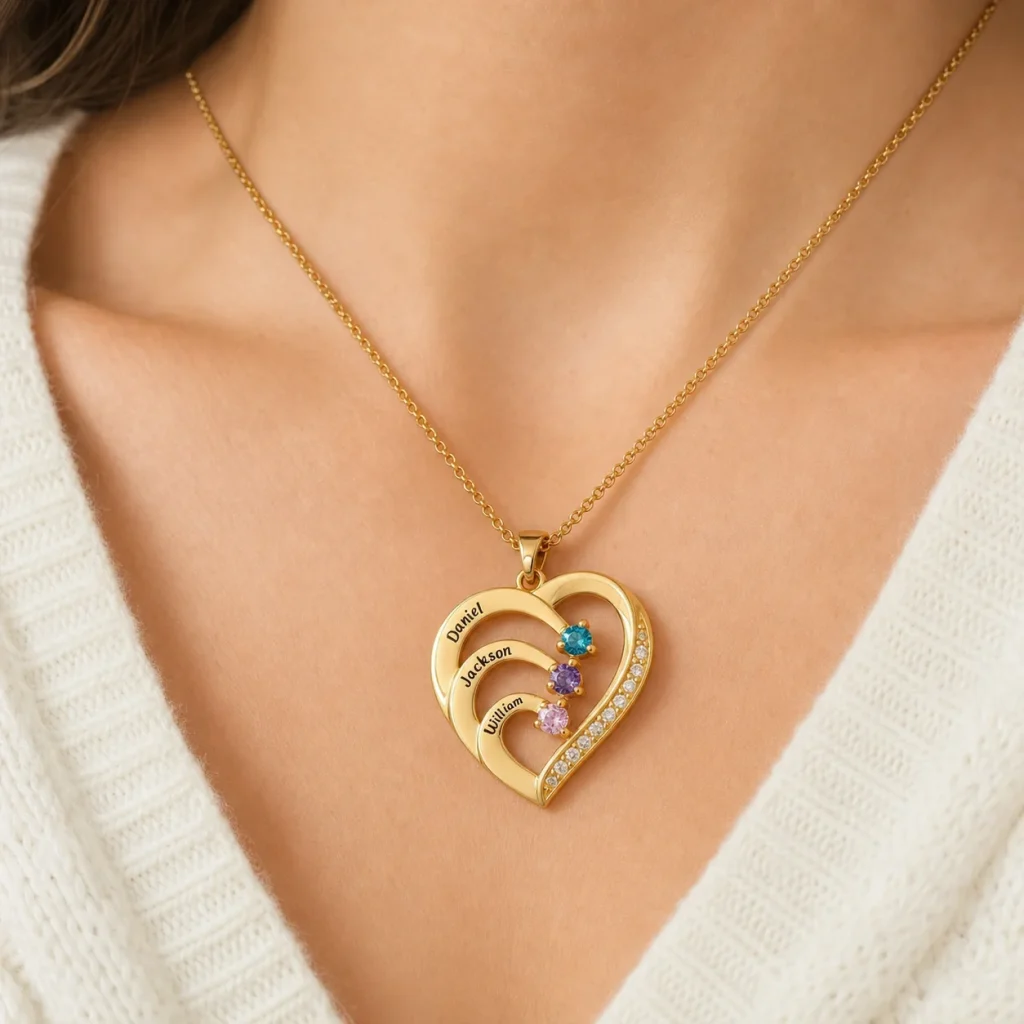
A month-led design can connect people through names and simulated birthstone cues across separate homes. A name-led design can keep the focus on identity when the recipient prefers less color or when every month cannot be verified.
The Family Embrace Heart Necklace supports one to six names, each paired with a simulated birthstone selection. Its layered heart structure can suit one wearer who wants the current family gathered in a single necklace.
The Gathered Hearts Name Necklace supports one to eight engraved name beads without a birthstone-month field. Compare these information systems before tone or decoration.
Make two paper versions using the same family scope. One lists names only; the other pairs names with months. Ask which version the recipient would understand and wear more naturally. This separates the information decision from product photographs.
Choose for the recipient’s current routine
A transition can change clothing, work, travel, exercise, or time spent away from home, but do not assume any specific new lifestyle. Observe the necklaces the recipient still wears and the scale that works with ordinary necklines.
Family Embrace records an approximately 22 mm pendant and a 50 cm chain plus 5 cm extender. Use those measurements as comparison points, not universal placement labels. If the recipient rarely wears necklaces, another format in the current collection may be more appropriate.
Plated jewelry should be kept dry, removed for showering, swimming, and exercise, protected from perfume and household chemicals, wiped gently, and stored separately.
A changed household may also change storage. Choose one dry place that remains easy to reach after closets, bathrooms, or bedrooms are reorganized. Include the care note without asking the recipient to preserve an old family routine.
Create an adult-child review process
Ask each adult child to confirm their own display name and birth month. Use one coordinator to maintain the final order and mark earlier versions as drafts. This avoids a parent or sibling choosing an outdated nickname on someone else’s behalf.
Review count, order, names, months, tone, and product. Follow the personalization process and keep the submitted map. A separate digital preview is not part of the current promise.
Give any fuller transition message in a card. The jewelry does not need to explain where everyone lives.
Keep a final family key with the order. Separate addresses are unnecessary; names, months where used, and positions are enough. The map should describe connection without collecting private location information.
Common questions
Should the parents’ names be included?
Include them if the agreed story is the whole family. Leave them out if the piece specifically represents the children. There is no automatic empty-nest rule.
Should a child’s partner be added?
Ask whether that relationship belongs in this particular family circle. Do not let available capacity make the decision.
What if an adult child uses a different name now?
Use the display name they approve. Personalized jewelry should reflect current identity rather than preserving an old household label by default.
Represent connection without freezing the household
Children can leave home while family remains central, but the piece should not pretend nothing changed. Define the current circle, confirm adult names and months, choose the right information system, and match the wearer’s present routine. The result can hold connection across homes without turning a past household arrangement into the only family story.